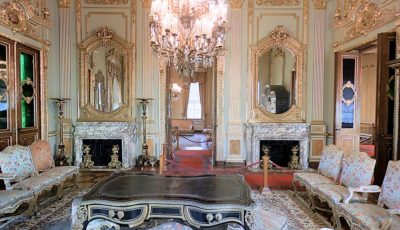
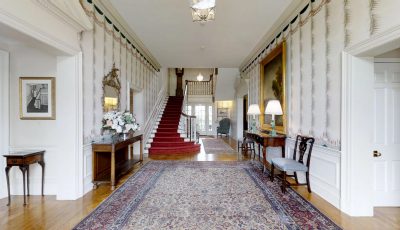
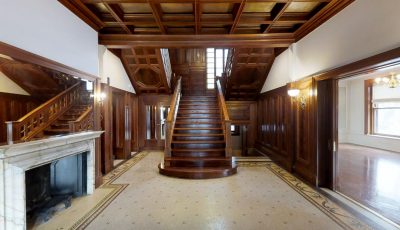
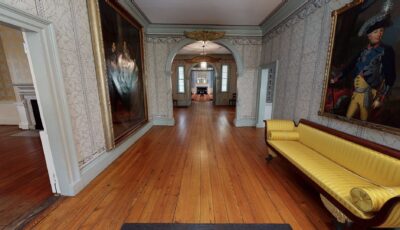
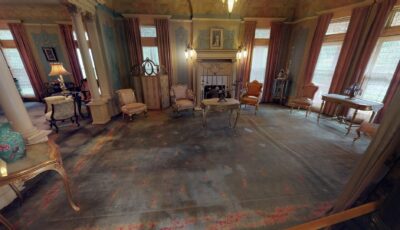
The White House is the official residence and workplace of the president of the United States. Located at 1600 Pennsylvania Avenue NW in Washington, D.C., it has served as the residence of every U.S. president since John Adams in 1800 when the national capital was moved from Philadelphia. The White House is also a metonym for the Executive Office of the President. The residence was designed by the Irish-born architect James Hoban in the Neoclassical style. Hoban modeled the building on Leinster House in Dublin, a building which today houses the Oireachtas, the Irish legislature. Constructed between 1792 and 1800, its exterior walls are Aquia Creek sandstone painted white. When Thomas Jefferson moved into the house in 1801, he and his architect Benjamin Henry Latrobe added low colonnades on each wing to conceal what then were stables and storage. In 1814, during the War of 1812, the mansion was set ablaze by British forces in the burning of Washington, destroying the interior and charring much of the exterior. Reconstruction began almost immediately, and President James Monroe moved into the partially reconstructed Executive Residence in October 1817. Exterior construction continued with the addition of the semicircular South Portico in 1824 and the North Portico in 1829. Because of crowding within the executive mansion, President Theodore Roosevelt had all work offices relocated to the newly constructed West Wing in 1901.
Information sourced from Wikipedia, licensed under CC-BY-SA.
Educational Lesson Plans
Enhance your classroom experience with our comprehensive educational lesson plans designed to accompany this virtual tour. Each lesson plan aligns with national educational standards and includes pre-tour activities, guided exploration questions, discussion prompts, and post-tour assessment materials. Perfect for grades K-12 and higher education.
Share This Virtual Tour
Know someone who would enjoy this virtual field trip? Share this 3D tour with teachers, students, friends, and family. Virtual field trips make learning accessible to everyone, regardless of location or ability to travel.